CHAS is very grateful to Canterbury Christ Church University student, Isabelle Keogh, for selecting and researching information on 12 postcards from the Derek Butler collection, and for the text below. In many cases it is difficult to identify the groups or locations shown in the images, so if any website visitor has further information, please do get in touch via the contact form.
Women’s experiences are overall less researched in history than men’s. It is important to look at the things women and girls would get up to. These postcards show what women and girls in Canterbury were doing in their day to day lives within the early to mid 20th century.
Early 20th century
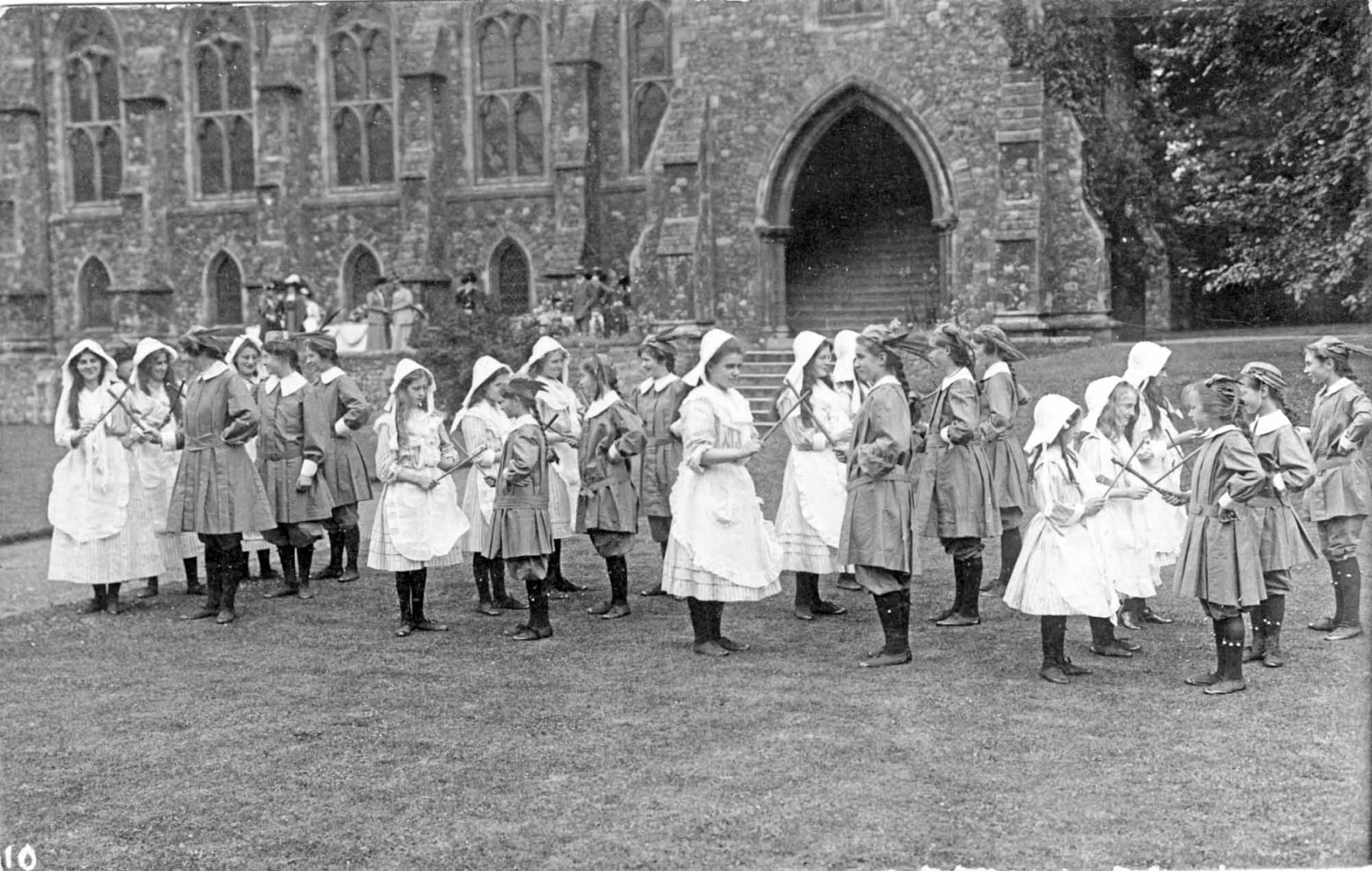
1901- Country dancing at St Augustine’s Abbey by Simon Langton Girls’ School
The first postcard depicts girls from Simon Langton Girls’ School dancing outside St Augustine’s Abbey. Simon Langton Girl’s School was progressive for its time, as its headmistress, Miss Amelia Henrickson Proudfoot, sought to strive against the limited opportunities the Edwardian Era had for girls. The values that were viewed to be important during this era was ‘grace and bearing’ and ‘skilfulness of hand, especially in the home arts’. Miss Proudfoot expanded girls’ horizons by increasing their access to physical activity and provided exceeding levels of academic achievement.[1]
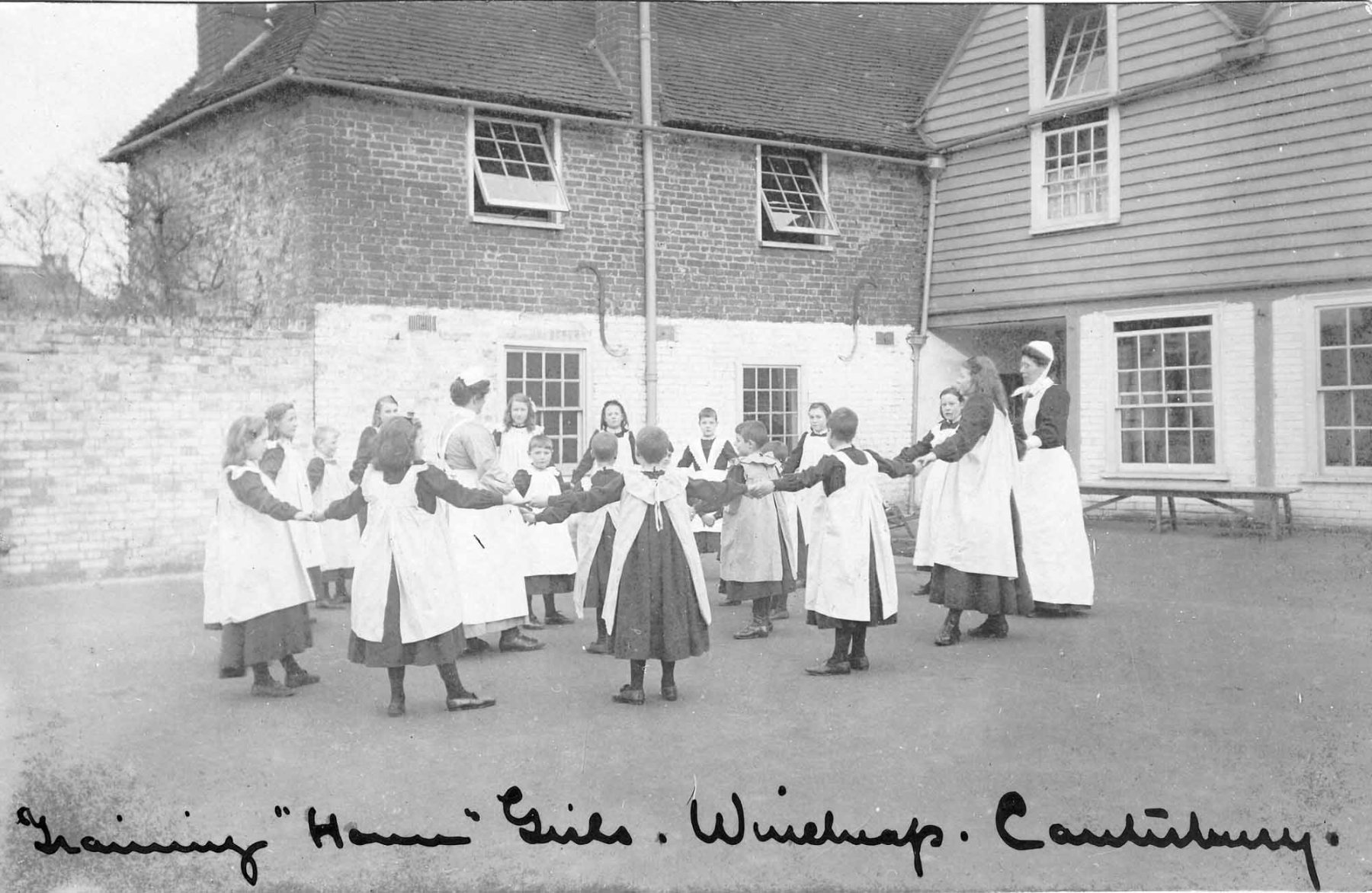
1908- Girls’ Training Home Wincheap
The second postcard shows girls playing or dancing outside their Training Home in Wincheap in 1908. The building was originally, in 1865, an Industrial Girls’ School, which was a type of school that was set up to house and care for destitute and delinquent children.[2]
In 1906, it was taken over by the Waifs and Strays Society, who changed the name of the Training Home to be ‘Queen Bertha’s Home for Girls’.[3] It housed and educated girls aged 9-14 into domestic service. However, it did not accommodate many, as in 1908, it had space to hold only 24 girls.[4] The girls who lived there styled themselves as the ‘Canterbury Bells’, like the ones in the Cathedral nearby. Not long after, the home had reached its end; closing in 1919.[5]
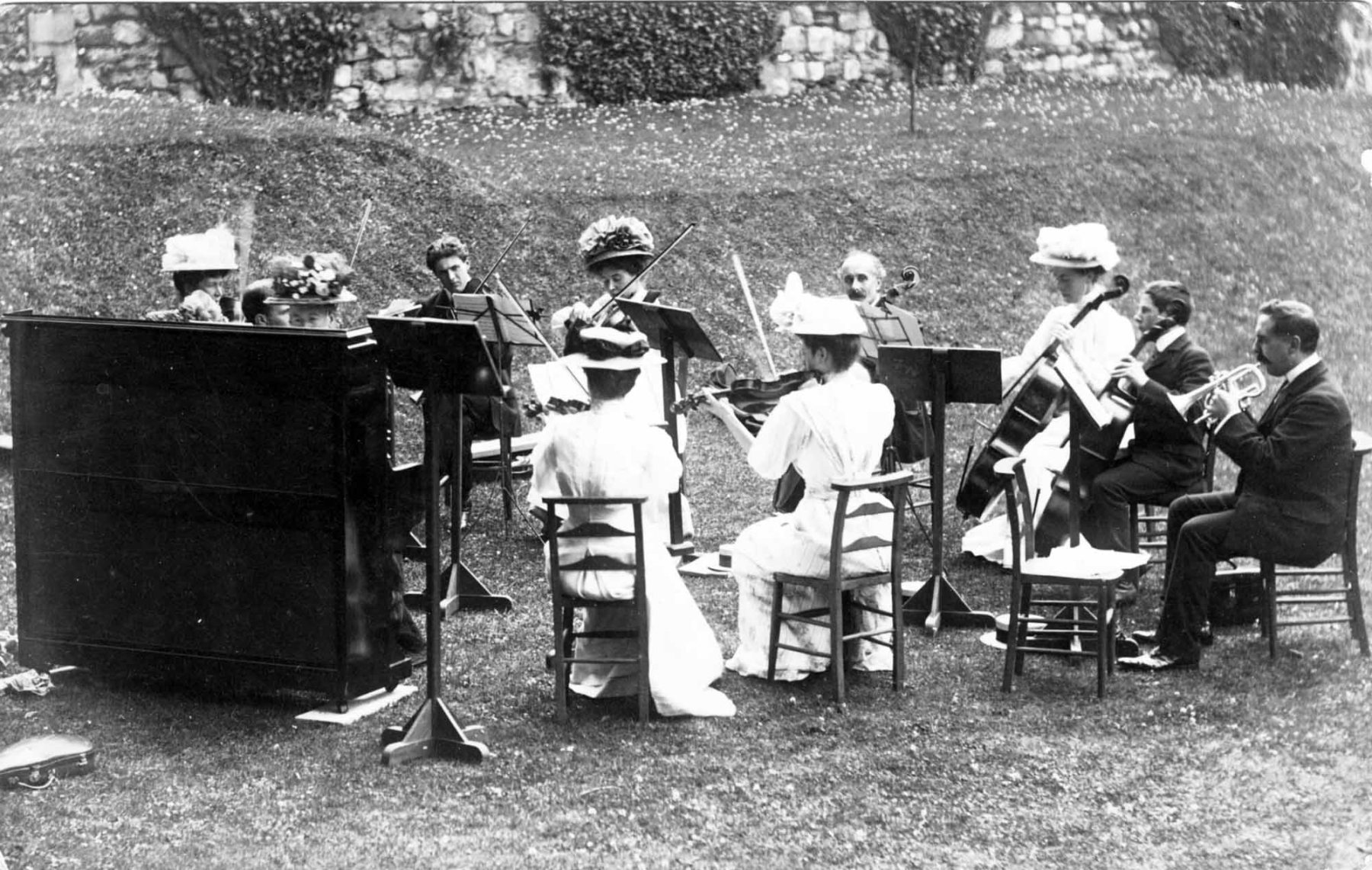
1911- Local orchestra
The third image depicts a local Canterbury orchestra playing music on what is most likely to be the Cathedral Baptistry Garden. The stone wall protected the walkway that ran along the top of the Great Dormitory Undercroft, which was hidden under the earth slope. These features however, along with the Cathedral’s Victorian Library, were destroyed during the Second World War. Therefore, this backdrop behind the orchestra no longer exists. This postcard shows that in the early 20th century, one of the things that women could do was be part of playing and performing in Orchestras.
Thank you to Paul Crampton who has provided CHAS with this information.
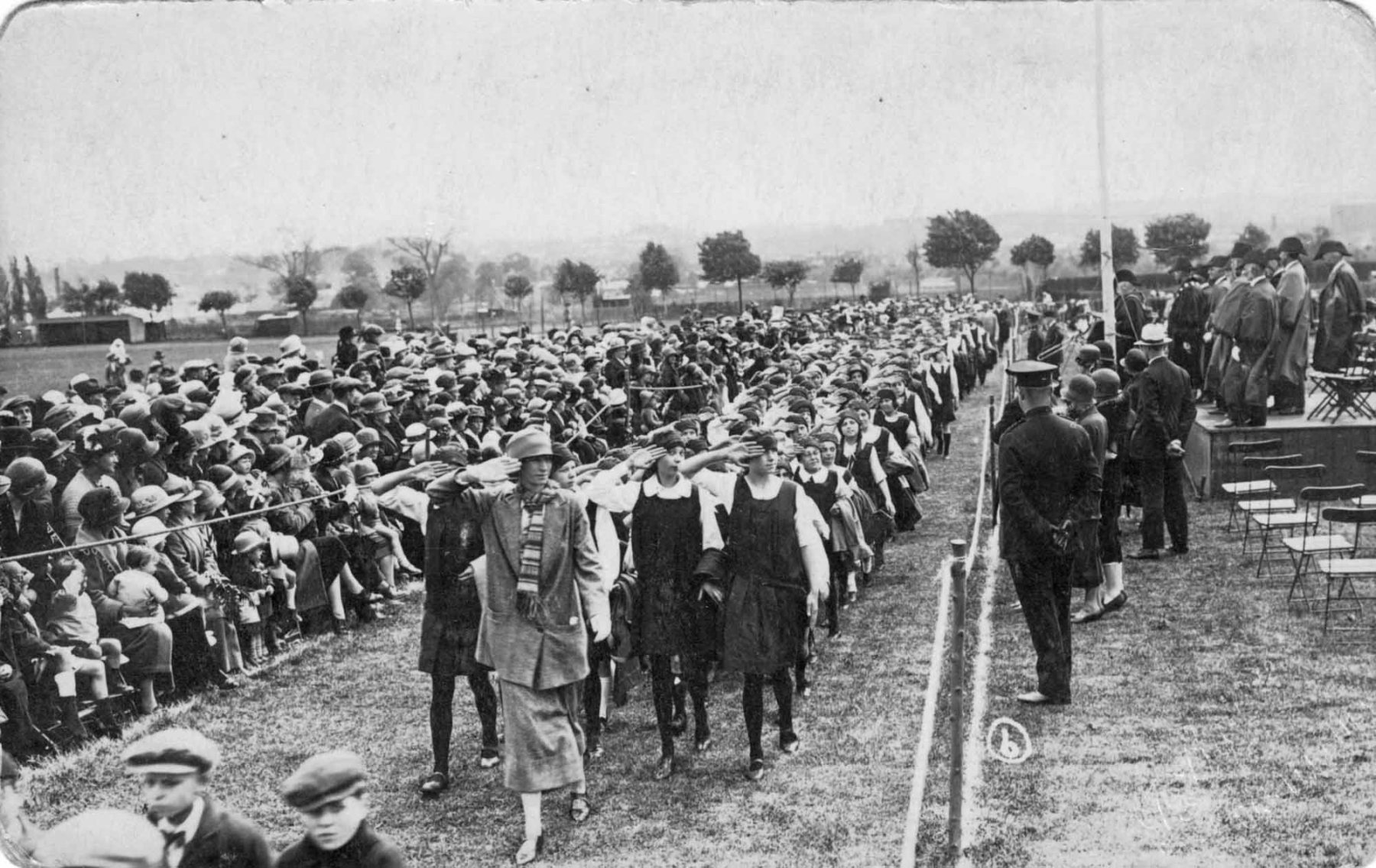
1920s- Parade, Victoria Recreation Ground
The fourth postcard is showing Empire Parade Day at the Victoria Recreation Ground. When this was taken, in the 1920’s, this space was known as Victoria Memorial Playing Fields, which were developed across ten acres for £1,600. It opened in 1907. The girls parading past are from Simon Langton Girl’s School.[6]
Empire Parade Day was a celebration of the British Empire, which took place on the 24th May, as it was Queen Victoria’s birthday.[7] After the Second World War, Empire Day became a more solemn occasion, with a stronger focus towards remembrance of those who had died in the war.[8] In 1958, after the collapse of the British Empire, this day of celebration was changed to be known as ‘Commonwealth Day.’ The date was also changed to be celebrated on the birthday of Queen Elizabeth II but was altered once more in 1977 to be on the second Monday in March.[9]
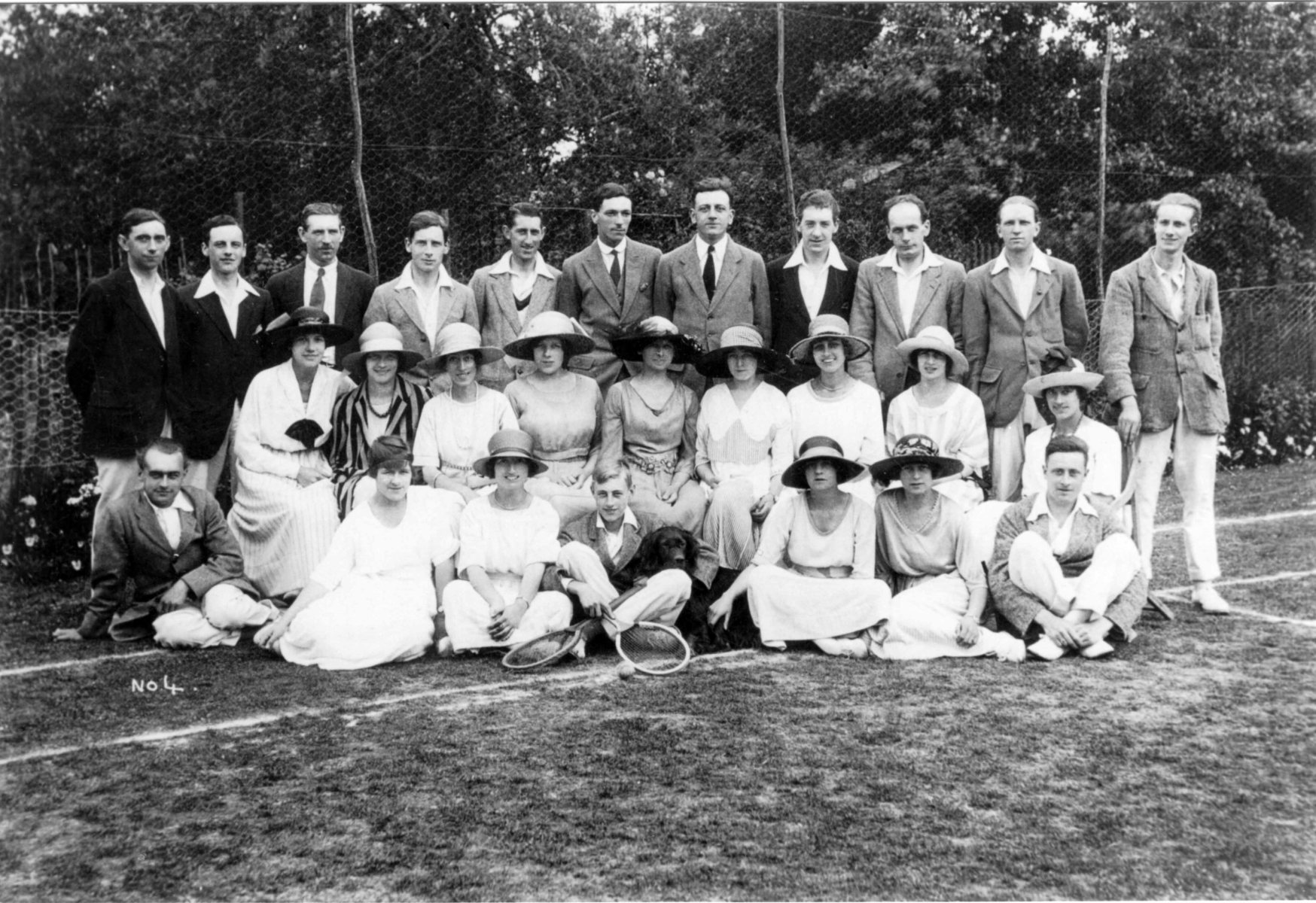
late 1920s- Tennis Club (Sturry Road)
The fifth postcard depicts both male and female members of what is most likely to be the Island Road Tennis Club in Upstreet, Sturry. It was advertised as having a ‘Good Hard Court’.[10] This image shows that both men and women liked to play Tennis in their free time.
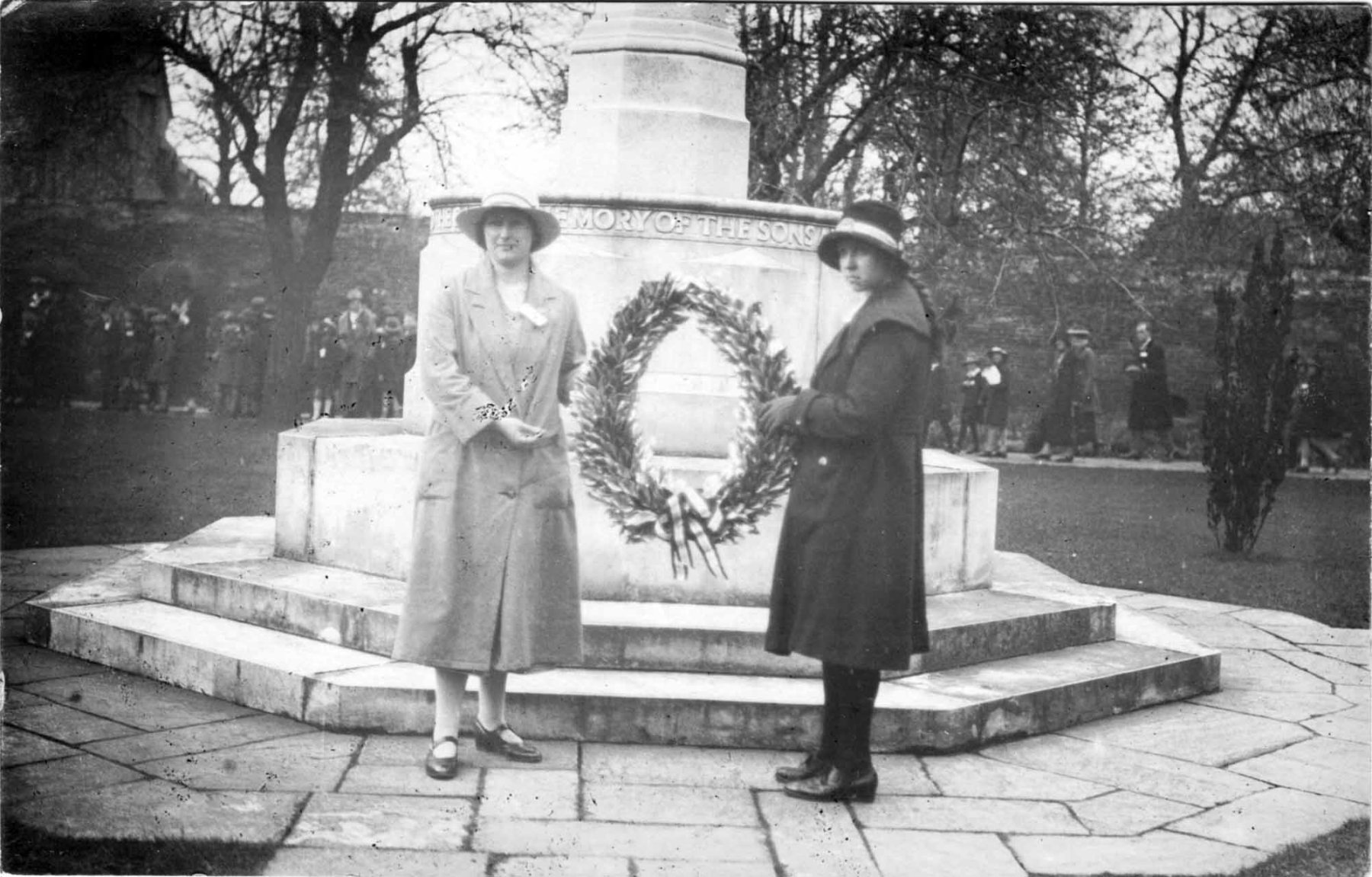
1920s- Canterbury Cathedral war memorial
The sixth postcard depicts two women holding a wreath at the County Kent War Memorial in the Harris Memorial Garden within the grounds of Canterbury Cathedral.[11] The memorial, which was unveiled in 1921, reads ‘TO THE SACRED MEMORY OF THE SONS AND DAUGHTERS OF KENT WHO DIED IN THE GREAT WAR 1914-1919’. The women involved in this image and exact date this picture was taken is unknown. However, women frequently played significant roles in war memorials, often laying wreaths as wives of fallen soldiers.
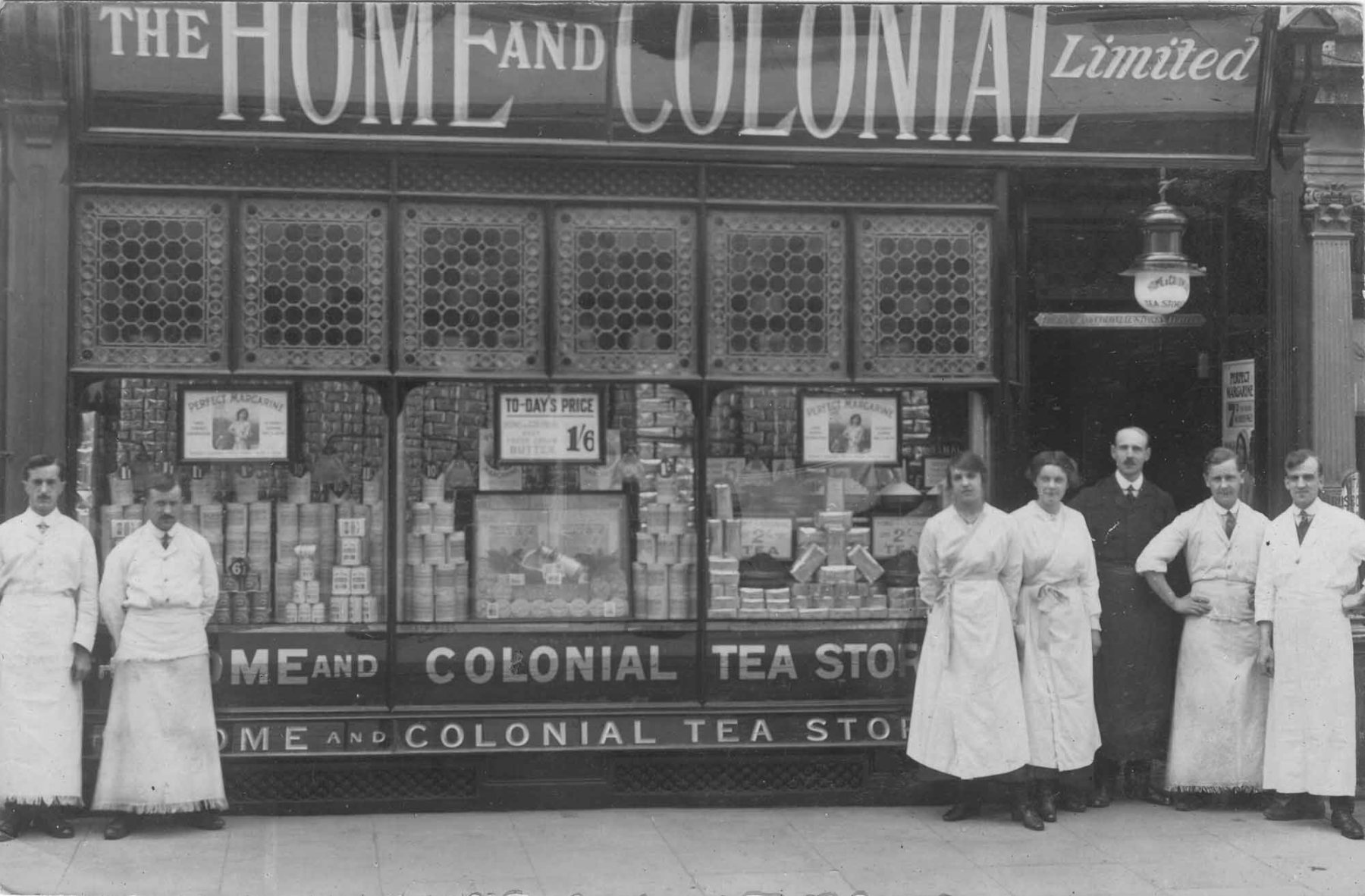
1930s- Home & Colonial Tea Store High Street/St George’s Street
The seventh postcard shows shop assistants standing outside The Home and Colonial Tea Store in St George’s Street, Canterbury. Home and Colonial Tea Stores first emerged in 1888. They were popular for selling tea, coffee, sugar; and butter and margarine, which were imported from around the British Empire.[12] Margarine and butter are seen advertised in the shop windows of this Canterbury store. When the British Empire came to an end, these Home and Colonial Tea Stores closed down.
1930s- Carnival Littlebourne Road (A346)
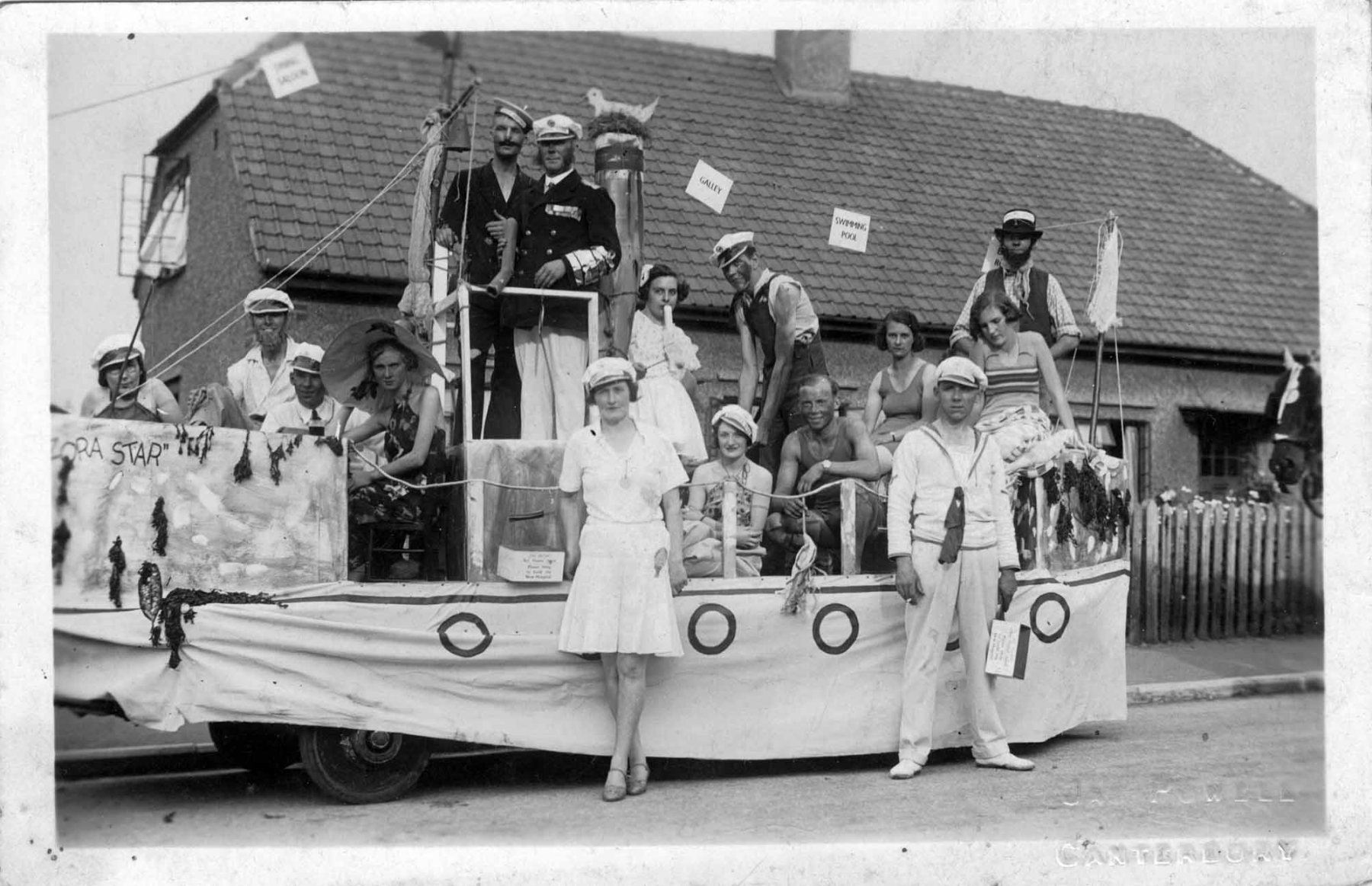
The eight postcard depicts the nautical carnival float ‘Zora Star’ at the assembly point in Littlebourne Road in the 1930’s. The image was taken by James Powell of Palace Street. The carnival float was to fundraise the building of the new Kent and Canterbury Hospital, which opened in 1937. The crew can be seen holding collection boxes which said ‘Please help to build the New Canterbury Hospital’. This postcard demonstrates that taking part in carnivals that helped fundraising was another thing that women could be part of in Canterbury.
1930s Leftover’s store social gathering
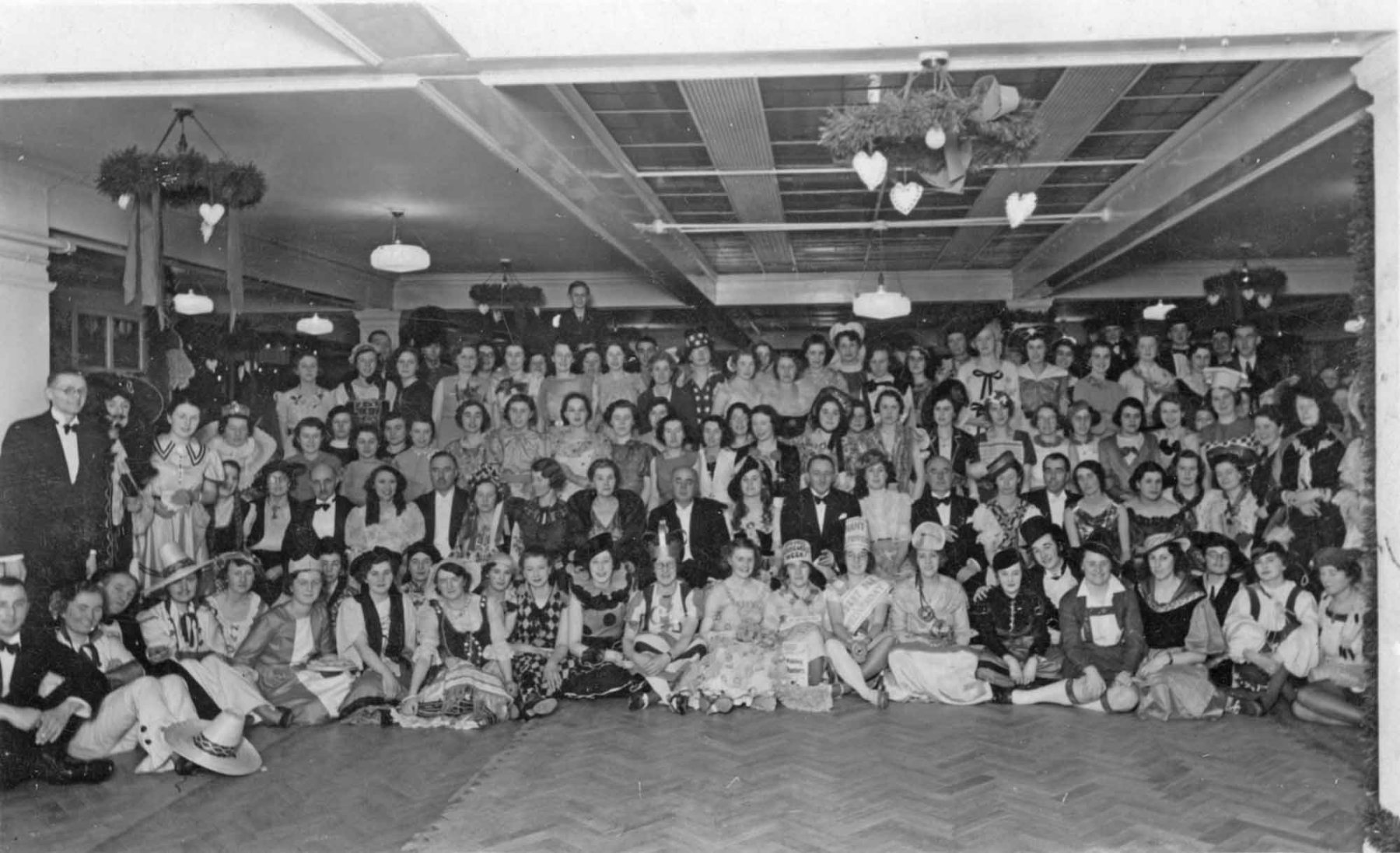
The ninth postcard shows a social gathering in the 1930s of people who worked at Lefevre’s, which were mainly women. Lefevre’s was the first department store in Canterbury, residing in Guildhall Street.[13] It was a luxurious store, with an Art Deco exterior, Egyptian style windows and a sweeping staircase.[14] Lefevre’s was such a success, that the owner, Lefevre, sold it to Debenhams, which operated under the original buildings name until 1973.[15]
1930s- group in cast costume (more information needed)
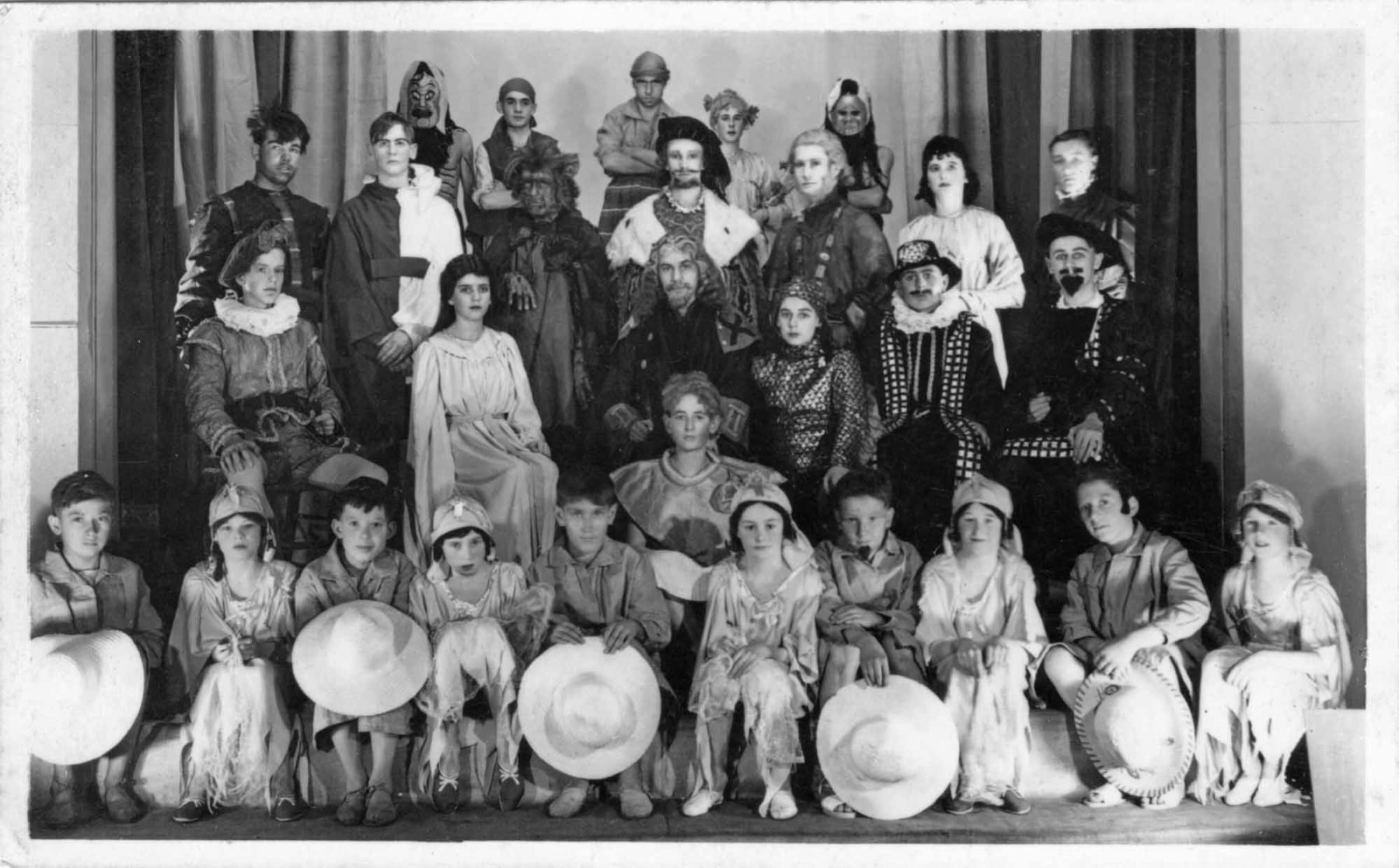
The tenth postcard is showing a Canterbury theatre group in their costumes for a production. Unfortunately, the theatre group and the production they were performing is unknown. However, it shows that women and girls were involved in theatre productions.
1930s- Women’s dance group (more information needed)
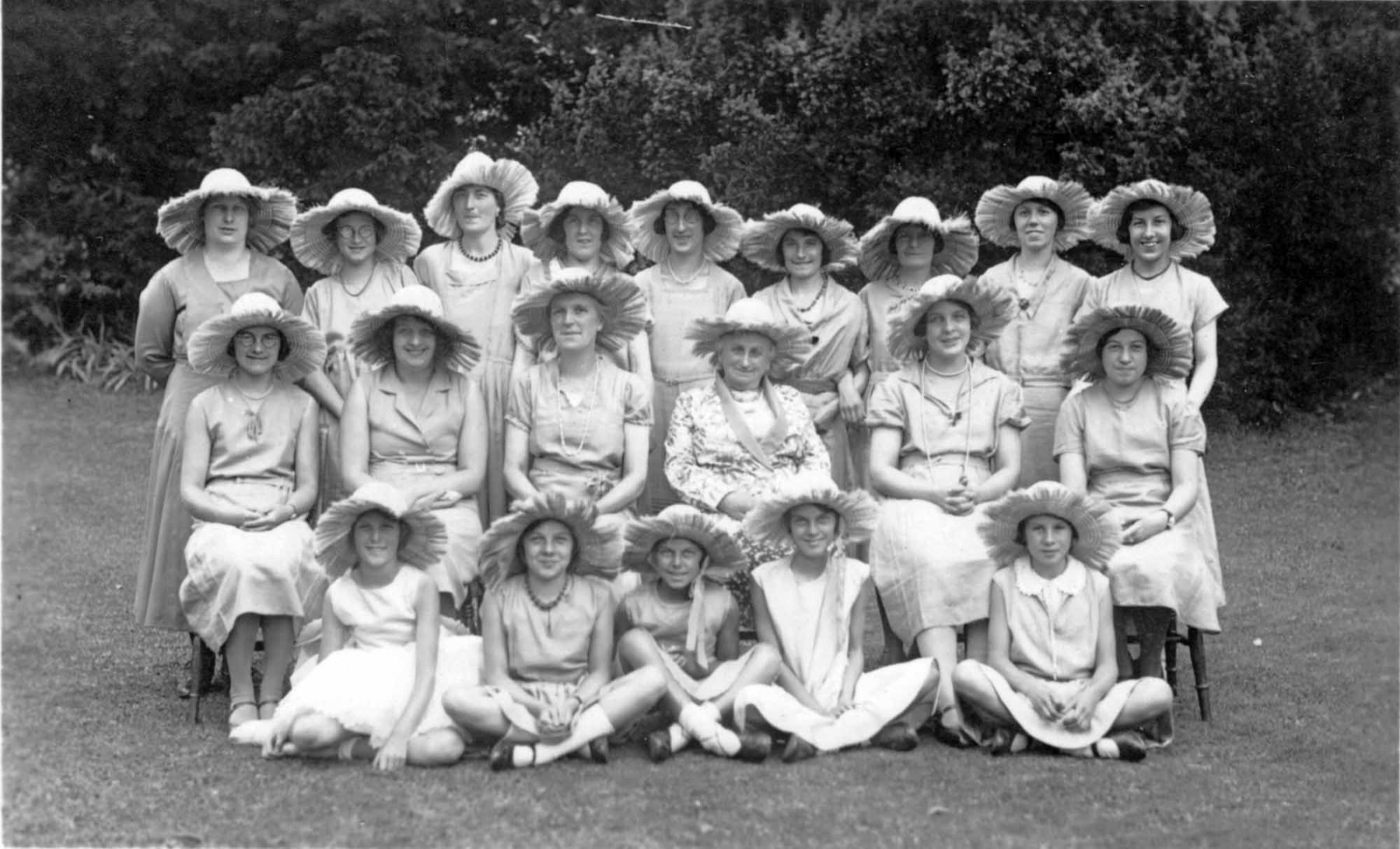
The penultimate image depicts a local dance group, which is comprised of girls and women from a range of ages.
1930s- Hospital fundraising
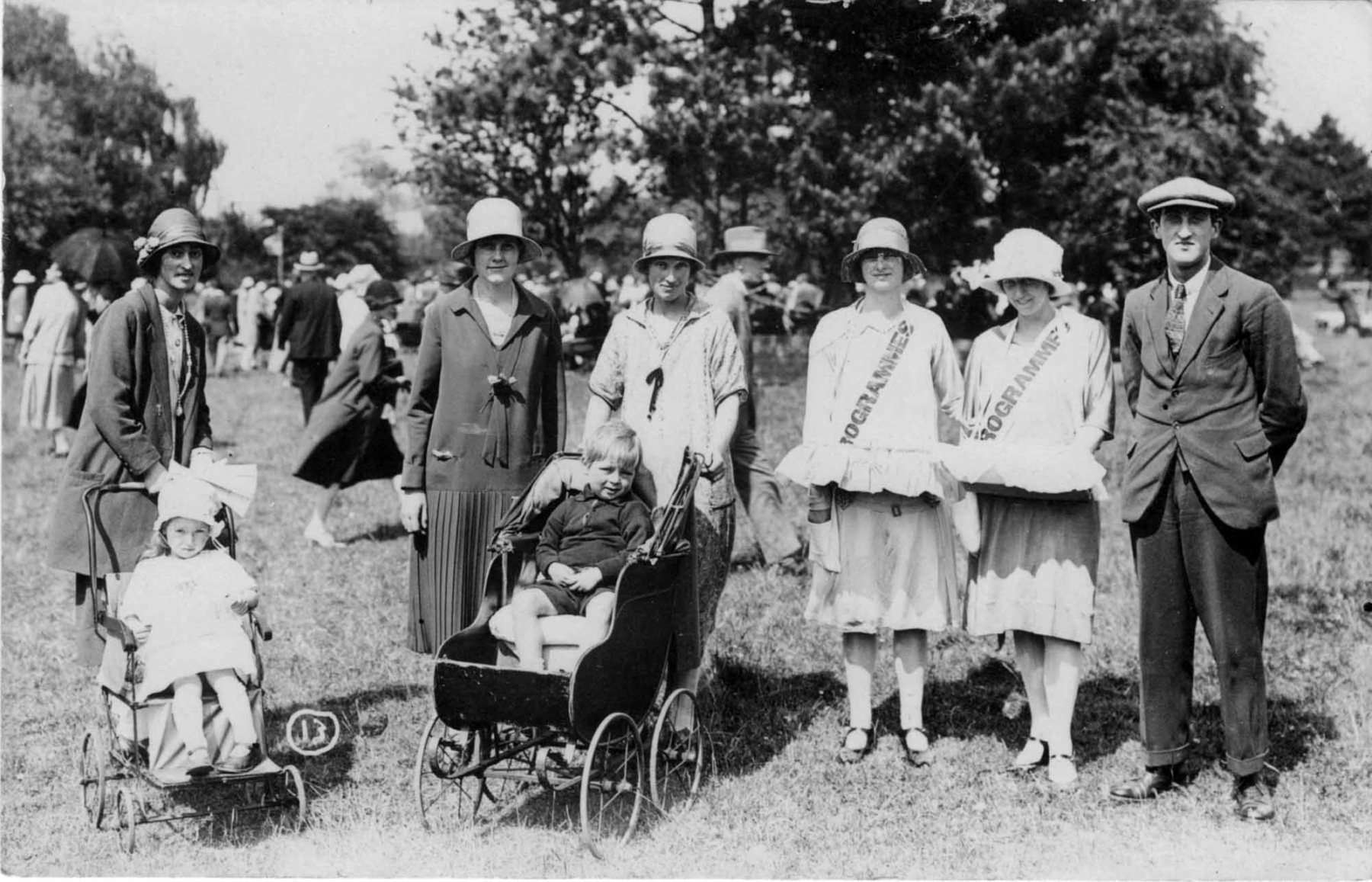
This postcard is showing women taking part in fundraising for a local hospital, which is thought to have been held on the south east of Ethelbert Road. It is most likely to be for the Kent and Canterbury Hospital which first opened in 1937, on that site. Women played a big part in fundraising and charity work.
Isabelle Keogh April 2026
Click on any of the images below to enlarge the pictures on your screen
Bibliography
Building Our Past. “The Legacy of Home & Colonial Stores,” 2016. https://buildingourpast.com/2016/03/05/the-legacy-of-home-colonial-stores/.
Butler, Derek. Britain in Old Photographs. Canterbury Revisited. Sutton Publishing Ltd, 1997.
Children’s homes. “Wincheap Training Home for Girls / Queen Bertha’s Home, Canterbury, Kent.” Childrenshomes.org.uk, 2017. https://www.childrenshomes.org.uk/CanterburyWS/.
English, Jim. “Empire Day in Britain, 1904-1958.” The Historical Journal 49, no. 1 (2006). https://www.jstor.org/stable/4091747.
Gear, Gillian Carol. “Industrial Schools in England, 1857-1933 ‘Moral Hospitals’ or ‘Oppressive Institutions’?” 1999.
Hidden Lives. “Hidden Lives Revealed: A Virtual Archive – Children in Care 1881-1981.” Hiddenlives.org.uk. The Children’s Society, 2025. https://www.hiddenlives.org.uk/homes/CANTE01.html.
Isle of Thanet Gazette. “Island Road Tennis Club, Upstreet.” Isle of Thanet Gazette, May 14, 1927.
IWM. “Kent County War Memorial – WW1 Cross.” Imperial War Museums, 2018. https://www.iwm.org.uk/memorials/item/memorial/16472#.
Johnson, Ben. “Empire Day.” History Magazine: History UK, n.d.
Maltby, Richard. “20th-Century Canterbury: Retail.” Kent Maps Online, July 2021. https://www.kent-maps.online/canterbury/20c-canterbury-retail-store/.
Senechal, Mr. “Our History – Simon Langton Girls’ Grammar Sixth Form.” Langtonsixthform.co.uk, 2022. https://www.langtonsixthform.co.uk/about-us/our-history.
[1] Mr Senechal, “Our History – Simon Langton Girls’ Grammar Sixth Form,” Langtonsixthform.co.uk, 2022, https://www.langtonsixthform.co.uk/about-us/our-history.
[2] Gillian Carol Gear, “Industrial Schools in England, 1857-1933 ‘Moral Hospitals’ or ‘Oppressive Institutions’?” (1999). Page 2.
[3] Children’s homes, “Wincheap Training Home for Girls / Queen Bertha’s Home, Canterbury, Kent,” Childrenshomes.org.uk, 2017, https://www.childrenshomes.org.uk/CanterburyWS/.
[4] Hidden Lives, “Hidden Lives Revealed: A Virtual Archive – Children in Care 1881-1981,” Hiddenlives.org.uk (The Children’s Society, 2025), https://www.hiddenlives.org.uk/homes/CANTE01.html.
[5] Ibid.
[6] Derek Butler, Britain in Old Photographs. Canterbury Revisited (Sutton Publishing Ltd, 1997). Page 61.
[7] Ben Johnson, “Empire Day,” History Magazine: History UK, n.d.
[8] Jim English, “Empire Day in Britain, 1904-1958,” The Historical Journal 49, no. 1 (2006), https://www.jstor.org/stable/4091747. Page 275.
[9] Ben Johnson, “Empire Day,” History Magazine: History UK, n.d.
[10] Isle of Thanet Gazette, “Island Road Tennis Club, Upstreet,” Isle of Thanet Gazette, May 14, 1927.
[11] IWM, “Kent County War Memorial – WW1 Cross,” Imperial War Museums, 2018, https://www.iwm.org.uk/memorials/item/memorial/16472#.
[12] “The Legacy of Home & Colonial Stores,” Building Our Past, 2016, https://buildingourpast.com/2016/03/05/the-legacy-of-home-colonial-stores/.
[13] Richard Maltby, “20th-Century Canterbury: Retail,” Kent Maps Online, July 2021, https://www.kent-maps.online/canterbury/20c-canterbury-retail-store/.
[14] Ibid.
[15] Ibid.