Field archaeologist, numismatist, CHAS treasurer, postcard collector
Tribute by Professor Paul Bennett, March 2026
It is with shock and great sadness that I pen these memories of my friend and colleague, Ian Anderson, seen and spoken to only a few short weeks ago and known for fifty years.
Many of us knew Ian, a friendly and familiar figure walking the streets of Canterbury, but how many really knew him. He was an intensely private person, famously monosyllabic, who was always around, invariably part of a team, and yet at the same time solitary, and rarely out-going or out-spoken. Always polite, but other than the usual pleasantries exchanged between friends and colleagues at work or in the pub, his voice was hardly heard. Rarely did Ian express an opinion on any subject unless it was work related, or about coins recently identified, or postcards newly acquired.
Ian was one of the Trust’s first volunteers, starting with us in 1976, indeed he was a volunteer working with the late Dr Frank Jenkins on his excavations at St Pancras Church, in 1974 and 1975, before the CAT was formed. He was then a clerk for Lloyd’s Bank and a member of the CAS. Frank’s team also included Simon Pratt, then a schoolboy who went on to read Archaeology and Anthropology at Cambridge, worked for many years in Rome and eventually returned to Canterbury as a Trust employee, and now recently retired.
Ian gave up his job at Lloyds to become an early employee of the Trust in July 1979 working on two excavations in the precincts, near the Norman Staircase and in the Mint Yard. It was at this time that he became the Treasurer of CAS, later CHAS. This post and the responsibilities it brought became an important part of his life. In forty-five years of service, he hardly missed a committee meeting or a CAS lecture or event. He was a truly dedicated Treasurer and member of the CAS and CHAS committees and will be a very hard act to follow.
Although Ian loved being a field archaeologist, his great passion was the study of Iron Age and Roman coins and medieval and post-medieval jettons and trading tokens. Although he amassed a small coin collection, his great joy was studying the subject intensively. It was at the core of who he was. Establishing a small reference library, he spent most Saturdays in the Broad Street office of CAT or more recently at the Archaeological Stores in Wincheap. Here, he sat at the same table with his books, packed lunch and small transistor radio (with sound turned low), researching coins for the sheer love of it, or identifying coins from the Trust’s most recent excavations, or preparing catalogues and reports for publication, invariably in manuscript. Most of the Trust’s major monographs contain a contribution from Ian. By the time the typist was given his script, it had been copied out so many times that the paper looked and felt like vellum.
Ian was an enthusiastic collector of Canterbury postcards and had an enviable private collection. He had great difficulty entering the age of computers. He never used a computer for work or report writing but persisted admirably with a machine to acquire sufficient skills to buy and sell postcards on-line. Most of his early postcards were obtained from organised fairs but as these became a rarity when the market moved on-line, he was forced to learn how to connect with eBay and other sites to expand his collection. Recently, he engaged in an on-line bidding war for a rare Canterbury postcard, winning the engagement in the last second of bidding, only to discover the following day that the opposition had been a very disappointed postcard collecting friend and work colleague.
Another of his passions was gardening and particularly working his allotment. He lived with his mother and stepfather all his life and inherited the family home, garden and allotment after they died. Most allotment holders find maintaining a single allotment difficult, but Ian had two, growing both flowers and vegetables. I have yet to discover what he did with his surpluses! Although he inherited the family home he was obliged to take out a mortgage late in life to secure sole ownership, guaranteeing the bank that he would continue working into his mid 70’s, a perfect arrangement for Ian who loved his work. The mortgage was settled only recently.
Ian was an engaged and diligent field archaeologist and loved the variety of sites he worked on, rarely complaining about adverse weather conditions. There were times when he was ill, but when fit, he was invariably punctual. He was a great one for stripping off to the waist as soon as the sun shone. He suffered for it later in life with skin cancer on his back that was successfully treated, but it did lead to time off work which vexed him. He was notoriously forgetful at times particularly when the pick-up point for work outside Canterbury varied, but he walked everywhere from his home in Essex Road and I’m not sure I ever saw him riding a bike. In 2010, we needed car drivers for work outside the city, and I circulated a staff memo asking to hear from anyone with a current driving license and was surprised to hear from Ian. He informed me that he passed his driving test at 18 and had maintained his license but had not driven a car since his test and had no intention of starting now!
Ian was an accomplished and experienced excavator but did not like overseeing others. He liked the idea but not the actuality of doing so. The main problem lay with communication, and yet he was perfectly capable of discussing interpretations of what was being excavated and how it should be recorded, and there were few on the payroll more experienced. In the end he agreed that supervising excavations was not for him, but he was perfectly suited and content to be an important member of a field team occasionally wearing a coin specialist hat. In doing so, and throughout his long career, he made vital contributions towards the archaeological record as both a field archaeologist and as an in-house specialist, recognised and respected by fellow numismatists.
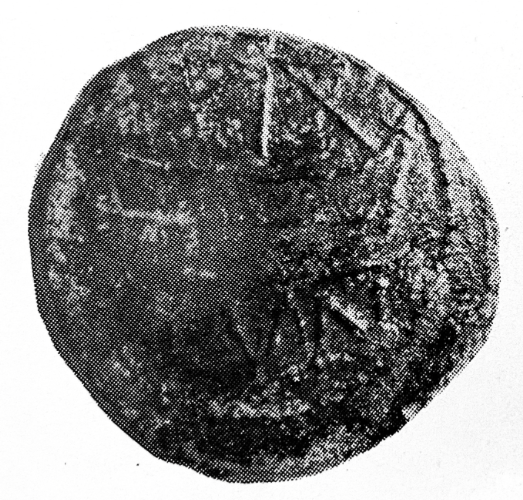
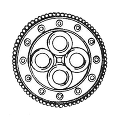
Ian was involved with a long list of spectacular discoveries, too many to discuss here, but I remember Ian the Trust volunteer finding a unique, unknown copper-alloy coin of Cunobelin dating to the early first century AD, featuring a fully rigged trading vessel on the obverse, at 76-79 Castle Street in 1977 (Plate 3) and Ian the employee, excavating a large pit against Adelaide Place in 1980, within the Roman Temple precinct (Plate 4). The pit contained an adult male, an adult female, two female juveniles and a dog on the lap of the adult male. The bodies together with personal jewellery had been thrown into the pit in the late fourth century, perhaps during a major epidemic, and had remained exposed to the elements for a period, before being buried. Ian did a brilliant job excavating them. More recently, in an excavation near Teynham against Watling Street in 2024, Ian excavated a deep pit associated with a roadside Roman temple complex, containing a broken but complete statue of a Triton, (Plate 5), one of the most significant discoveries of sculpture in Roman Britain for many years (Plate 6 and 7). I saw Ian but a few weeks ago in the Wincheap stores where he was happily engaged washing pottery from a recent excavation (to him, digging and washing finds were all part of the job). I asked him if he had any intention of retiring soon. His brief response was typical, ‘No, I’m still enjoying the work’.
Many of Ian’s colleagues will remember his incredible ability to fall fast asleep as soon as the works vehicle started its engine for the drive to and from work or during lunch breaks while supposedly reading a newspaper. Others will remember evenings in the pub and his bizarre antediluvian dress sense, as if living in the 1970’s, with floral shirts baring huge collars and flared trousers. He was a gentle man of regular habits, whether at work or ‘at play’ with his coin books and postcards in a quiet Saturday office, or during visits to favoured pubs, leaning on the bar with a pint amongst friends, but saying very little.
Ian never married, but he had many female friends within the Trust and in the local community. He was famously non-verbal, and this was probably the reason why his romantic relationships never progressed. He was a lovely man with a great sense of humour, often at his own expense (Plate 1), and was universally liked. Few of us knew him well, but he will be sorely missed by everyone.
Ian Anderson, field archaeologist, treasurer, numismatist, postcard collector, monosyllabic colleague, and friend to many, was born on 2nd April 1951. He died in his sleep in the family home after a short illness, just before 5th of February 2026.
Paul Bennett, February 2026
Illustrations
Plate 1: Ian Anderson (photo, Jess Twyman)
Plates 2–3: Coin of Cunobelin found by Ian on the Cakebread Robey site (77-79, Castle Street) in 1977.
Plate 4: The multiple burial from Adelaide Place, excavated in 1985 (Photo, Paul Bennett)
Plate 5: Ian excavating the statue of Triton (photo, Richard Helm)
Plate 6: Ian holding the head of Triton (Photo, Richard Helm)
Plate 7: Statue of the Triton